Karen’s Final Descent
House of LeavesKaren’s Final Descent is the climactic act of rescue in which Karen Green enters the black space of The house on Ash Tree Lane to recover Will Navidson. She crosses the threshold despite terror, finds Navidson near death, and emerges with him into the front yard after the house seems to dissolve around them. The descent therefore changes the story’s central opposition: the darkness is not defeated by measurement, force, or technological explanation, but crossed through attachment, bodily endurance, and the refusal to abandon another person.
The Threshold and the Decision
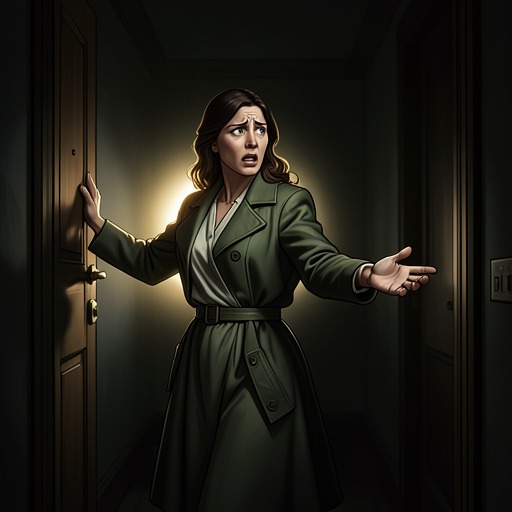
Karen’s decision follows a moment of apparent emptiness. After turning around and seeing that the space behind her has become a “real emptiness,” she does not scream; her chest heaves as though her body cannot yet take anything in or expel anything out. She retreats from the children’s bedroom, then returns several minutes later carrying a halogen flashlight. The movement is hesitant but not passive: she approaches the edge again, points the light into the darkness, and calls for Navidson.
The scene remains deliberately uncertain about what prompts her return. Hanan Jabara proposes that Karen heard something, although the Hi 8 recording contains nothing resembling a sound. Carlos Ellsberg likewise interprets her pause as a response to an imagined noise, arguing that the mind imposes itself on the abyss. The darkness thus offers no reliable summons. Karen acts at the point where evidence fails, and her decision becomes an answer to absence rather than a response to confirmed knowledge.
When Karen finally steps across the threshold, the action is stripped of ceremony. She takes no deep breath and makes no announcement. She simply moves forward and disappears behind the black curtain. A second later, the cold hollow is gone and the wall has returned to its former condition. Only the children’s drawings have vanished. The disappearance makes the threshold more than a doorway: it is a temporary rupture in the house’s reality, one that closes after Karen has committed herself to it.
Entry into the Darkness
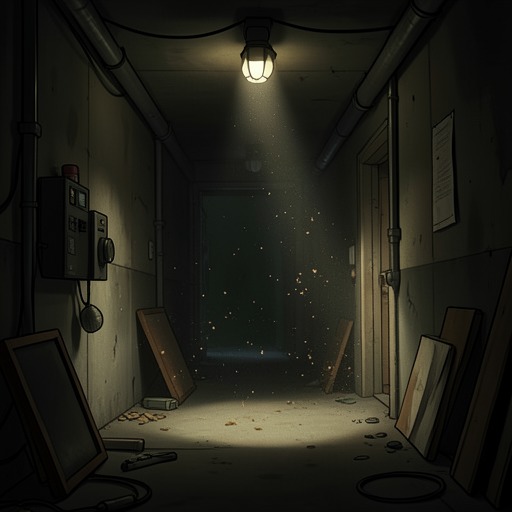
Karen’s own later account emphasizes the physical extremity of the descent. As soon as she enters, she begins shivering in the cold and dark. When she turns to look back, the place from which she came has disappeared. She hyperventilates, cannot breathe, and believes she is going to die. The experience removes the ordinary structure of movement: there is no visible route back, no stable architecture, and no assurance that forward motion leads anywhere.
Nevertheless, Karen continues by placing one foot in front of the other until she finds Navidson. She does not know that he is there, but she has been thinking that he must be. The discovery reverses the emotional charge of the space. Navidson lies naked and curled at her feet, his hand white with cold; confronted with his condition, Karen says that it no longer matters where she is. Her fear gives way to a sense of freedom, not because the darkness becomes comprehensible, but because the presence of the person she came to save becomes more important than the location imprisoning them.
The rescue is completed through touch and adjustment rather than command. Karen holds Navidson and cradles his head in her arms. When he makes a sound, she initially cannot understand him, then realizes that the flashlight is hurting his eyes. She turns it off and holds him in the darkness. The gesture abandons the instrument that had allowed her to see and replaces illumination with physical closeness. In this moment, darkness is no longer merely an obstacle to be overcome; it becomes the space in which Karen protects Navidson from further pain.
Dissolution and Return
Karen cannot provide a conventional account of how she and Navidson leave the house. Her explanation is that it “just dissolved,” like a bad dream. They remain in pitch-blackness until she feels warm, sweet air on her face. Her eyes are closed when the transition occurs; on opening them, she sees trees and grass. For an instant she interprets the scene as the realm after death, but it turns out to be the front yard of the house.
The return therefore does not establish a clear mechanism of escape. The house may have disappeared, or Karen’s perception may have passed through an experience that ordinary spatial language cannot contain. The interview’s unanswered question about whether the house dissolved preserves that uncertainty. What can be established is the consequence: Karen and Navidson are restored to the yard, while the architecture that held them has withdrawn from view.
Forty-nine minutes after Karen enters the darkness, a neighbor sees her crying on the front lawn with a pink ribbon in her hair and Navidson cradled in her lap. The image joins exposure and tenderness. Karen is no longer only the person who feared the house’s interior; she is the person carrying its survivor back into ordinary space. The pink ribbon and the grass of the yard provide small, concrete signs of the familiar world after an experience that had threatened to erase every point of reference.
Navidson’s Survival
Navidson’s physical condition confirms the cost of the rescue. An ambulance takes him to the hospital, where Billy Reston catches up with the pair. Navidson’s core temperature has fallen to 83.7 degrees Fahrenheit. Because the doctors lack a cardiopulmonary bypass machine capable of replacing his cold blood with warm, oxygenated blood, they cut into his abdominal cavity, insert catheters, and irrigate his internal organs with warm fluid.
The treatment raises his core temperature only to 85.3 degrees at first, and the EKG continues to show the peculiar J wave associated with hypothermia. Additional liters of saline are added to the IV while the doctors keep watch. One hour passes, and most of those present believe Navidson will not survive another. He does survive, and the film and tapes made during his journey survive as well. The outcome preserves both the rescued body and the record through which the descent can later be examined, disputed, and retold.
Love, Vision, and Meaning
The event is presented as a turning point in Karen’s relation to fear. Her love for Navidson is identified as the primary catalyst that allows her to cross the threshold, overcoming the memories of the dark well, the abuse carried out by her stepfather, and whatever remains concealed in her childhood. The action does not erase those shadows; it places them within a larger decision in which Karen’s attachment becomes stronger than the terror they have helped organize.
Guyon Keller connects Karen’s success to her earlier acts of seeing Navidson clearly. By relearning to see him, Keller argues, Karen also begins to see herself more clearly. This interpretation makes the descent the physical culmination of a perceptual change: the threshold is crossed only after Karen’s vision has ceased to be governed entirely by fear, concealment, or distance. Sophia Blynn extends the same logic to Navidson, suggesting that the light Karen carries into the darkness is ultimately the memory of Navidson himself, and that his final utterance may have been the beginning of her name rather than a warning.
The scene’s decisive value shift is from isolation to contact, and from anticipated death to shared survival. Karen enters without proof that Navidson is alive and without any guarantee that she can return. She finds him, relinquishes the flashlight when it harms him, holds him until the space changes, and carries him back into the world. Yet the ending refuses to convert love into a complete explanation. The darkness remains fundamentally unknown; what changes is not the abyss but Karen’s willingness to enter it, and the fact that this willingness brings Navidson back alive.